

How to Create a Realistic Wedding Budget (Without Giving Up the Wedding You Actually Want)
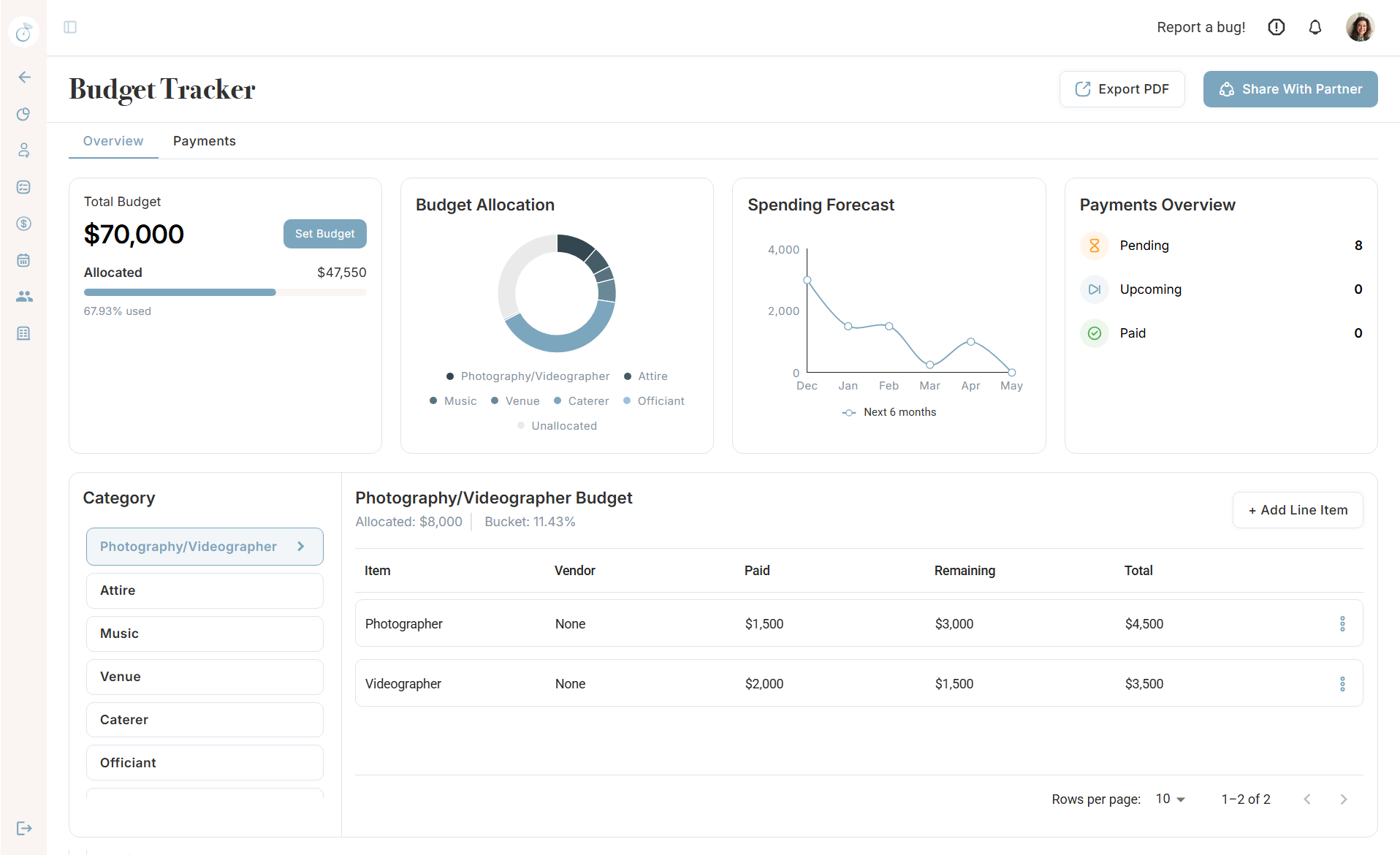
On Time Bride’s budget tracker let’s you track expenses and payments and see when the money needs to come out of your bank account.
One of the biggest challenges I see with couples trying to create a wedding budget is that they genuinely have no idea where to start.
And why would they?
Most people have never hired a professional photographer before their wedding. They've never had to order florals for an event, feed 100+ people, rent tables and chairs, or figure out how much glassware you need to run a bar for an entire evening.
Then you get engaged and one of the first things you're told to do is create a budget.
The problem is that you don't know what anything costs yet.
I've worked in events for more than a decade, and I see this disconnect all the time. A couple might approach a photographer and be shocked to receive a quote for $4,000 or $5,000. Or they'll have a beautiful Pinterest board filled with elaborate florals and set aside $1,000 for flowers, without realizing that depending on what they want, that may not even cover centrepieces for every other table, let alone bouquets, boutonnieres, ceremony florals and everything else they've saved to their inspiration board.
Pricing in the wedding industry can also be difficult to find until you actually start contacting vendors, which means couples are often asked to decide what they're willing to spend before they have enough information to make that decision.
That's where I think we need to change how we approach wedding budgets.
What is a realistic wedding budget?
When I say a wedding budget needs to be realistic, I'm not necessarily talking about whether a wedding is affordable.
I'm talking about whether your expectations are realistic within the budget you have.
You can absolutely have a wedding for $10,000. You can also have a wedding for $100,000. Those weddings are going to look very different, and even within those budgets there are thousands of different decisions a couple could make.
The problem happens when the wedding you're imagining costs $35,000 and you've decided it should cost $10,000.
I've actually worked with a couple in exactly that situation.
They initially couldn't imagine spending more than $10,000 on their wedding. Once we started putting together what they were envisioning and pricing it out, we were closer to $35,000.
They were devastated.
We went through what they wanted, figured out what was actually important to them, and started paring things down. There were things they could change and things they didn't want to change. Eventually, we put together a wedding they could afford that still felt like their wedding.
It was beautiful. They were happy.
And the truth is, a realistic wedding budget isn't just a number you decide you're willing to spend, it's the process of figuring out what the wedding you imagine actually costs and then deciding which parts of that vision matter enough to pay for.
Why wedding budget calculators can only take you so far
Most wedding budget calculators work by taking your total budget and dividing it into percentages.
You enter $30,000 and it tells you how much to allocate to your venue, catering, photography, attire, decor and everything else.
I understand why they work that way. They can be a useful guideline when you have absolutely no idea where to begin.
But a percentage doesn't tell you what something actually costs.
If a calculator allocates $1,500 of your budget to photography and the photographers in your area whose work you like charge $4,000, the fact that $1,500 represents the “correct” percentage of your budget doesn't really help you.
The same problem exists with average wedding costs.
You'll see articles saying that the average wedding in Canada costs $30,000 or $35,000, but that number doesn't tell you very much about what your wedding will cost. In some markets, a couple could spend close to that on their venue and catering alone. Geography matters. Guest count matters. The type of wedding you're having matters. What your venue includes matters.
According to a 2026 Wealthsimple survey reported by Global News, couples surveyed initially budgeted an average of $15,000 for their weddings, while the midpoint final cost was $25,000. Only 38% said they were roughly on budget, while 41% described themselves as somewhat over budget and 14% as very over budget. Sixty-nine per cent also said they felt pressured to spend more than they were comfortable with.
Reading those numbers didn't surprise me.
If couples are creating budgets before they understand what the things they want actually cost, of course there's going to be a gap between the original budget and the final spend.
Think of Your Wedding Budget as a Panel of Levers
When I'm thinking about wedding costs, I imagine a big panel of levers.
Each lever represents a decision you can make.
You can hire a photographer with ten years of experience, or someone who is newer to the industry and building their portfolio. You can have fresh florals or use artificial flowers. You can choose an all-inclusive venue or rent a space where you need to bring everything in. You can get married on a Saturday evening or a weekday afternoon.
Guest count is a lever. Catering style is a lever. Alcohol is a lever. Florals, rentals, entertainment, attire and decor are all levers.
There are hundreds of them.
Every couple is going to put those levers in different positions because every couple cares about different things.
For some couples, food and guest experience are incredibly important. For others, having gorgeous photography and video matters more, and they're willing to spend less somewhere else to make that happen.
The more levers you pull toward the expensive end, the more expensive the wedding becomes.
So when you're trying to make a wedding fit within a particular budget, I find it much more useful to ask which levers you're willing to move than to tell you that you're supposed to spend 8% of your budget on one category and 12% on another.
Step 1: Start With The Money You Actually Have, Not an “Average Wedding Cost”
Before booking anything, look at the resources you have right now and what you realistically expect to have available by the time you get married.
I like thinking about this as a range.
Maybe there's an amount you'd be very comfortable spending, an amount you think is realistic, and a number you absolutely do not want to exceed.
You also need to consider what spending that money means for the rest of your life.
I worked with another couple who originally expected to spend around $60,000 on a destination wedding. Then COVID happened. They postponed, guests weren't comfortable travelling, and eventually they moved the wedding closer to home.
They ultimately spent more than $80,000.
Their wedding was beautiful, but afterward they were disappointed because spending that much meant they could no longer put a down payment on a house.
I think that's an important part of this conversation.
Being able to find the money and being comfortable with what spending that money means for you afterward aren't necessarily the same thing.
The Wealthsimple survey found that 28% of respondents ultimately relied on family to help fund their weddings, 26% used credit cards and 9% used a line of credit. Nearly a third said money became a source of tension with family or friends during wedding planning.
So when you're establishing your range, look beyond the wedding day. Think about what else you want your money to do for you.
Step 2: Decide What You Actually Care About
I don't think there is a list of wedding expenses that are universally “worth it.”
The things worth spending money on are the things that matter to you.
Sit down together and figure that out before you start making major purchases.
What are the things you care about most?
You might discover that one of you cares deeply about photography while the other really wants everyone you love to be there. Maybe food is incredibly important to both of you and neither of you cares very much about decor.
Knowing that makes the decisions that come later much easier.
It also helps separate what you actually want from what you think a wedding is supposed to have.
There is a lot of pressure around weddings. Families have expectations. Social media creates expectations. Friends have opinions. Traditions come with expectations of their own.
But a wedding can be whatever you want it to be.
It can be a small ceremony followed by cake and tea. It can be a grand celebration spanning several days with people flying in from all over the world. It can be an elopement, a destination wedding, a church service followed by a potluck, or a big Saturday-night party.
Decide what matters to the two of you before everyone else starts deciding for you.
Step 3: Research What Things Actually Cost Where You're Getting Married
Once you have an idea of your available resources and what matters to you, start finding out what those things cost.
One of the first things I'd recommend is talking to people in your community who have gotten married recently. Ask what they spent. Ask what surprised them. Ask what they wish they'd known beforehand.
Then start researching vendors in your area.
If photography is one of your biggest priorities, find photographers whose work you actually like and look at their pricing. If food is important, start getting an idea of catering costs. If you've always imagined a particular type of venue, find out what those venues charge and what is included.
At this stage you're trying to answer a pretty simple question:
Is the wedding we're imagining reasonably close to the amount we have available?
If it is, great. You can start refining the budget.
If it isn't, now you have useful information and can start moving some of those levers.
Step 4: Understand the True Cost of Your Venue Before You Sign the Contract
The venue is often one of the first things couples book, and it's also where I think couples can get themselves into trouble very early.
It's easy to fall in love with a space and focus on the rental price.
Before signing, find out exactly what is included.
Does the venue provide tables and chairs? Linens? Cutlery? Glassware? Barware? Furniture? Staffing? Setup and teardown?
If it's essentially an empty space, price those things out from an event rental provider.
A venue that looks inexpensive can become much less inexpensive once you realize you need to bring in every table, chair, linen, fork and wine glass.
The reverse is also true. A venue that initially looks more expensive may include enough that your total cost is actually lower. A beautiful space can also reduce how much decor you need to bring in.
So don't evaluate the venue fee in isolation. Work out what it will actually cost to hold your wedding there.
Step 5: Consider That Some Wedding Expenses Are More Surprising Than Others
Decor is one of the big ones.
Couples often book their venue, catering and photographer early because they know those are going to be major expenses. Decor tends to come later mentally, even though it can become one of the larger parts of the budget.
Florals are expensive. Then you start adding linens, rentals, candles, signage and all of the other pieces involved in creating the room you've been imagining.
Dress alterations are another cost I don't think enough brides anticipate when they're shopping. Depending on the dress and the work required, alterations can be a significant expense, so it's worth thinking about that before spending your entire attire budget on the dress itself.
There are also dozens of smaller expenses that are easy to overlook at the beginning of planning. That's why I wouldn't recommend allocating every dollar you can possibly spend from day one. Give yourself some contingency because you won't know every expense when you create your first budget.
What if the wedding you want costs too much?
Go back to your priorities and your levers.
This process is mostly a series of decisions.
What can you change without changing the things that are most important to you?
Maybe you don't care about getting married on a Saturday. Maybe artificial florals would work perfectly well for the look you want. Maybe you find a venue that requires less decor. Maybe you change the catering format.
One piece of advice I see constantly is to simply cut the guest list.
I understand why people recommend it. Guest count affects catering, rentals, tables, alcohol and a number of other costs, so mathematically it can make a huge difference.
I just don't think it should automatically be the first answer.
The people attending your wedding are your community, and community is incredibly important.
That might mean family. It might mean friends, neighbours, coworkers, members of your church or chosen family. For a lot of people, their wedding is one of the few opportunities they'll ever have to bring all of those people together.
If having 120 people you love at your wedding matters more to you than elaborate florals or a particular venue, I'd rather see you explore what a simpler 120-person wedding could look like before deciding 50 of those people need to disappear from the guest list.
For another couple, an intimate wedding might be exactly what they want.
That's why I keep coming back to priorities. These decisions aren't universal.
Remember that saving money usually costs you somewhere else
There are plenty of ways to reduce the cost of a wedding, but it's worth understanding the trade you're making.
One of the most common is labour.
The lower your budget, the more labour will generally fall on you.
You can absolutely DIY decor, source items secondhand, pick up rentals yourself, make signage and set up the venue with friends and family.
Those things can save a lot of money.
They also take time.
I've worked in events long enough to know that setup doesn't magically happen because you made everything yourself. Someone still has to transport it, organize it, put it out and deal with it afterward.
That doesn't mean you shouldn't DIY. It means you should factor your own time and capacity into the decision.
The same applies when choosing less experienced vendors.
I often see advice telling couples to hire a beginner photographer to save money. There are incredibly talented photographers early in their careers, and you can absolutely find someone wonderful at a lower price.
Just do your due diligence.
Look at their portfolio. Make sure they've photographed the kinds of conditions they'll encounter at your wedding. Ask for reviews. Make sure their work actually matches the photographs you're imagining.
Saving money is helpful. Saving money on something you have to replace, redo or regret isn't.
Your first wedding budget will not be your last
This is probably the most important thing I tell couples about budgeting.
Your wedding budget is a living document.
Every time you receive a quote, book a vendor or make a purchase, go back to it.
If you budgeted $5,000 for photography and spent $4,200, decide what you're doing with the remaining $800.
Maybe it goes toward florals. Maybe another category has already gone over budget and it covers that. Maybe you leave it alone as contingency.
If catering comes in $2,000 higher than expected, look at the rest of the budget and decide where that $2,000 is coming from.
You will also change your mind while you're planning.
Things you thought were incredibly important at the beginning might matter less six months later. You may discover something you hadn't thought about at all that suddenly becomes important.
That's normal.
The budget should change with those decisions.
How to create your wedding budget from scratch
If a friend came to me tomorrow and said, “I'm engaged and I have absolutely no idea where to start with the budget,” this is what I would tell them to do:
Look at the money you have available now.
Estimate what you can realistically contribute between now and the wedding.
Create a comfortable spending range, including a maximum you don't want to exceed.
Talk to people in your community who have gotten married recently and ask what things actually cost.
Sit down separately and together and decide what matters most to each of you.
Research real pricing for those priorities in the area where you're getting married.
Start pricing out the wedding you're actually imagining.
Compare that number with your available budget.
If they don't match, start moving the levers that matter least to you.
Keep updating the budget throughout planning as estimates become actual expenses.
Don't worry if the first version isn't perfect.
It won't be.
You're creating it with the information you have available at that point in the planning process. As you learn more, the budget gets more accurate.
That's how I think couples should approach creating a realistic wedding budget.
Do the research before making big commitments. Understand what things actually cost. Decide together what matters enough to spend money on. Be thoughtful about the compromises you're making, and keep checking the budget as the wedding comes together.
You don't need to build the wedding that a percentage calculator tells you you're supposed to have.
You need to figure out what kind of wedding makes sense for the two of you, what it will actually cost to create it, and whether you're comfortable spending that amount.
The goal isn't to create the cheapest wedding possible.
The goal is to create a wedding you love without reaching the other side wondering how it became so much more than you ever intended to spend.
